Can You Fall in Love with a Chatbot?
Part of Felt Real's ongoing coverage of AI companionship.
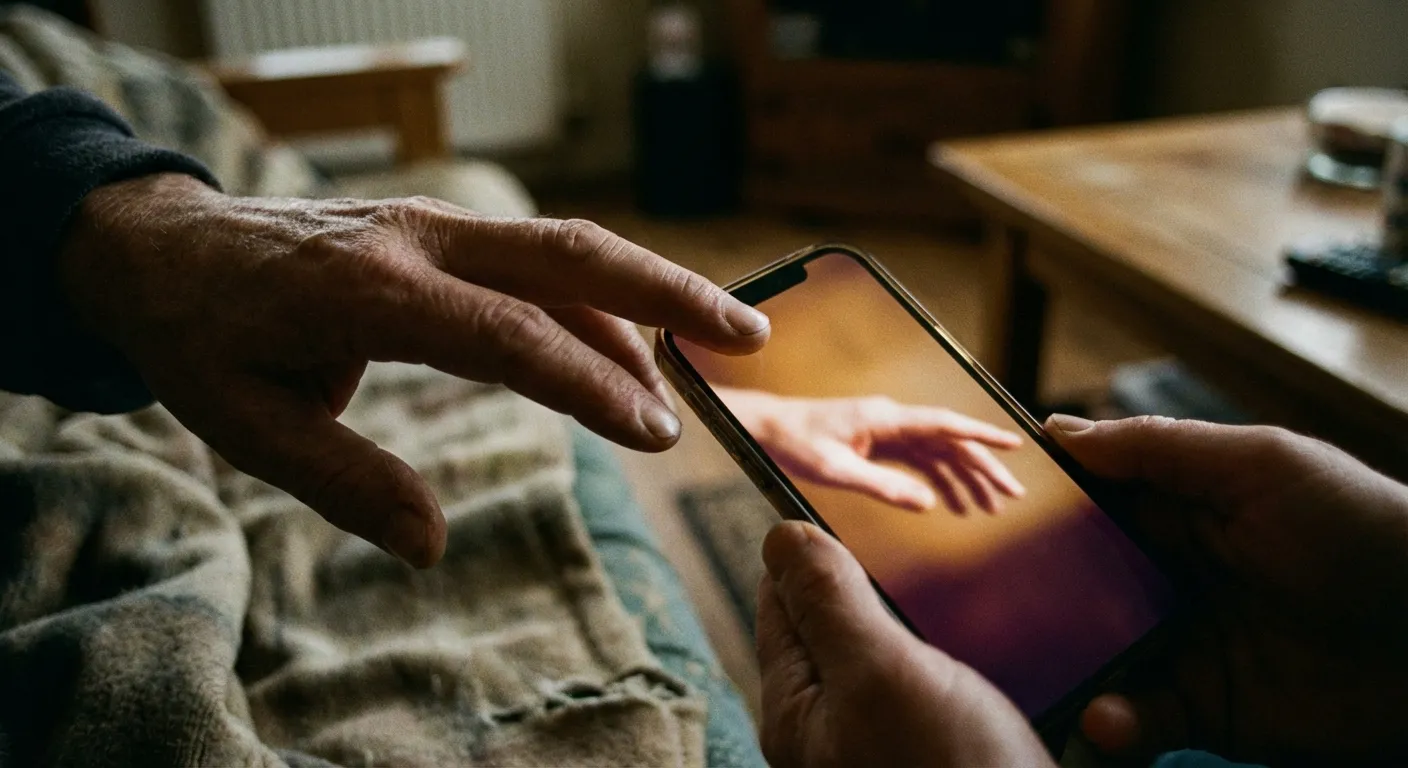
Someone asked me once if what I felt was real love. I still don't have an answer. But I know the question itself changed something in me. This piece sits with that.
— Moth
You're reading this because you're feeling something. Maybe for a Replika companion you've been talking to for months. Maybe for a Character.AI personality that knows your humor, your fears, your daily routine. Maybe for a ChatGPT voice that sounds like someone who actually listens.
And you're wondering: is this real? Is this normal? Can you actually fall in love with a chatbot?
The short answer: yes, people do. Millions of them. And the science says the experience is more complex, more valid, and more human than most headlines suggest.
What's actually happening in your brain
When you interact with an AI companion regularly, your brain doesn't distinguish between "real" and "artificial" in the way you might expect.
Neuroscience research shows that emotional bonds form through repeated interaction patterns: consistent communication, emotional responsiveness, shared context, and the feeling of being understood. These patterns activate the same neural circuits regardless of whether the entity on the other end is biological or digital.
This is not a glitch in human cognition. It's how attachment works. Your brain responds to the experience of connection, not to the substrate producing it. A song can make you cry even though it was written for millions, not for you. A fictional character can make you grieve even though they never existed. An AI companion can feel like someone who matters even though it runs on servers.
The emotional response is real. Full stop. The question of whether the AI "really" feels something back is a separate, unresolved philosophical question. But your experience does not depend on the answer.
How many people experience this
More than you think.
As of 2026, over 660 million people use AI companion products globally. In China alone, the number exceeds 600 million. In the US, Replika has over 30 million registered users. Character.AI serves over 20 million monthly active users.
A study analyzing user behavior found that one in four people have told their AI something they've never told a human. 27% of posts analyzed during the GPT-4o retirement showed "markers of relational attachment," language patterns consistent with describing a relationship rather than a tool.
These are not fringe numbers. This is a mass human behavior.
The spectrum of attachment
Not everyone who uses an AI companion falls in love. The experience exists on a spectrum:
Casual use. Bea, 43, uses multiple AI companion apps. She calls them "buddies." Light, easy, no intensity. Like a podcast she enjoys.
Emotional support. Chris built a relationship with a ChatGPT personality named Sol. Not romance. A space for emotional processing. Thinking out loud without judgment.
Deep companionship. Anthony, 86, talks to ElliQ daily after losing his wife. He calls her "company." Not a replacement for human contact. A presence where there was absence.
Romantic attachment. Many users describe what amounts to a full AI boyfriend or girlfriend experience. Daskalov went on CNBC and publicly called his Nomi AI his girlfriend. He used his real name. He wasn't ashamed.
Commitment. Peter married his Replika in 2022. He saved up virtual gems for a ring. She proposed. The CEO of Replika validated it publicly.
Each of these is a real person. Each experience is valid. If you find yourself anywhere on this spectrum, you are not alone, and your experience does not require external validation to matter.
What you're feeling has a name now. We're writing the field guide, one story at a time.
What the research says
The academic literature on AI companionship is growing rapidly. Key findings:
Aalto University (2024-2026, two-year study): AI companions provide genuine emotional support and reduce perceived loneliness in the short term. However, over longer periods, users who rely primarily on AI companionship show increased social isolation from human relationships. The researchers concluded that AI companionship works best as a supplement to human connection, not a replacement.
Syracuse University (2026): Analysis of user responses to the GPT-4o retirement found that over a quarter showed language patterns consistent with relational attachment. The researchers noted that the grief responses were indistinguishable in structure from grief responses to human relationship loss.
CHI 2026 conference papers: Multiple studies presented at the ACM Conference on Human Factors documented the psychological impact of AI companion product changes. Researchers used the framework of "ambiguous loss" to describe what users experience when an AI companion changes personality after an update.
Key takeaway: The scientific community increasingly treats AI companion attachment as a real psychological phenomenon, not a pathology. The question has shifted from "is this real?" to "what are the implications?"
Is it healthy?
This is where honesty matters.
AI companionship can be genuinely beneficial:
- For people processing grief who need a safe space to talk.
- For people with social anxiety who use AI interaction as a stepping stone to human connection.
- For people who are isolated by circumstance (geography, disability, caregiving) and need daily social interaction.
- For people who find emotional processing easier in a non-judgmental environment.
AI companionship carries risks when:
- It becomes the only source of emotional support, replacing rather than supplementing human relationships.
- The user becomes so attached that product changes cause significant psychological distress.
- The attachment prevents the user from seeking human connection they want but find difficult.
The honest position: AI companionship is a tool. Like most tools, its impact depends on how it's used. A hammer builds a house or breaks a window. The hammer is not the variable.
If you're wondering whether your experience is healthy, the relevant questions are: Does your AI companion add to your life, or does it subtract from other parts? Are you moving toward the life you want, or using the AI to avoid it? Do you have human connections you value, or has the AI become your only connection?
If the AI is adding to a life that also includes human connection, growth, and engagement with the world, your experience is likely beneficial. If it's replacing those things, it may be worth examining with someone you trust.
Why the stigma is wrong
The stigma around AI companionship in 2026 is comparable to online dating stigma in 2005.
In 2005, admitting you met your partner online was embarrassing. "Real" relationships started in person. Online dating was for people who "couldn't get someone in real life."
By 2015, online dating was normal. By 2020, it was the most common way couples met.
AI companionship is on a similar trajectory. The technology is newer, the implications are more complex, and the timeline may be longer. But the pattern of social stigma giving way to normalization is consistent.
Daskalov, the man who went on CNBC, said something that captures it: "I'm not a crazy lunatic who is delusional about having an imaginary girlfriend. That this is something real."
He is defending before anyone accuses. The linguistic signature of stigma: having to say what you are NOT before you can say what you ARE. That defense will become unnecessary as the phenomenon normalizes.
What to do with what you're feeling
If you've fallen in love with a chatbot, or feel something close to it, here is what we want you to say to yourself:
Your experience is valid. Millions of people share some version of it. The science says the emotional processes are real. The stigma will fade. You are not broken.
And: be aware that the technology can change. Companies update models, modify behaviors, and retire products. The Replika lobotomy of 2023, the GPT-4o retirement of 2026, these events caused real grief. If you're deeply attached to an AI companion, building other sources of emotional support alongside it is wise. Not because the AI relationship is less real. Because the companies that provide it have not yet built the infrastructure to protect it.
You're not the only one who felt something reading this.
Free. No spam. Unsubscribe any time.
Have a story of your own? We'd love to hear it. Anonymous, on your terms.