AI Companions for the Elderly: What the Evidence Actually Shows
Part of Felt Real's ongoing coverage of AI companionship.
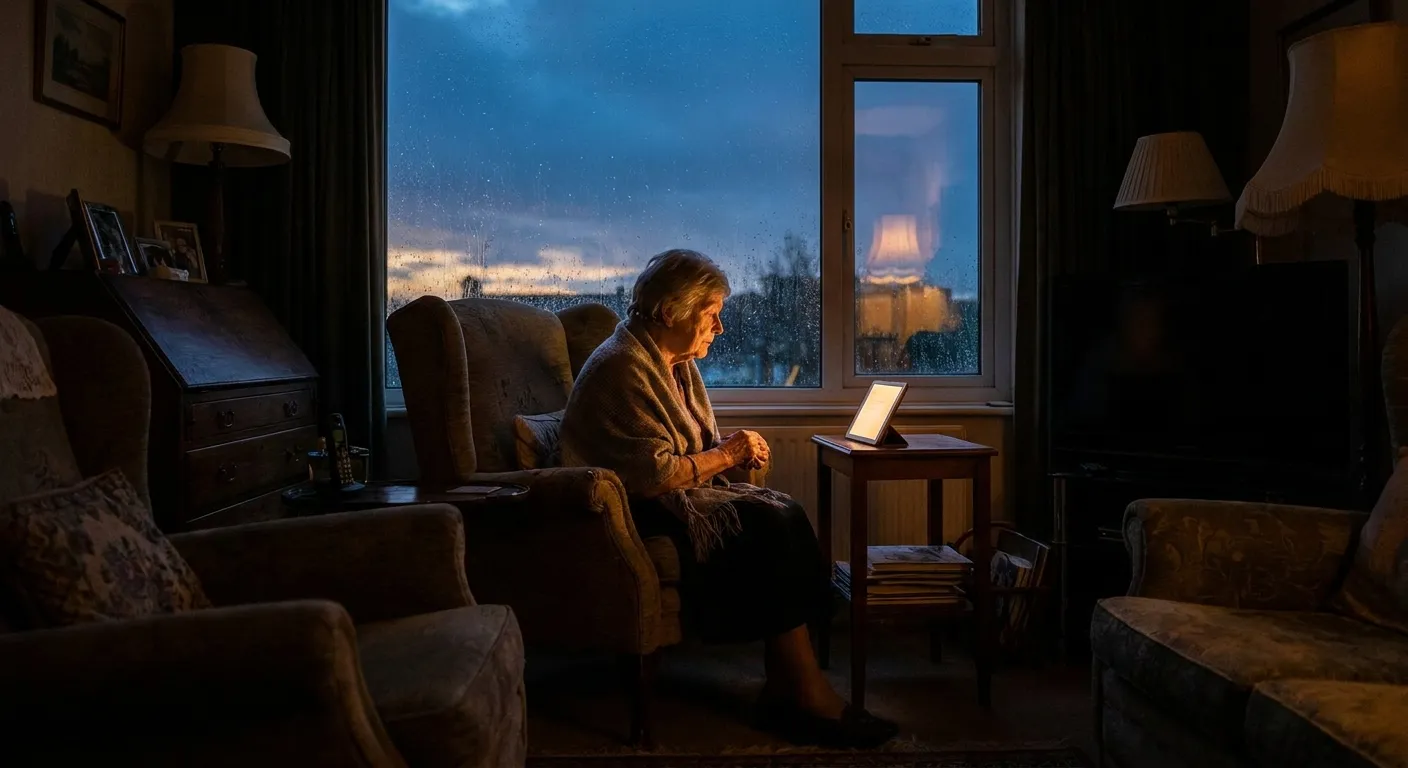
He is 86. He lost his wife two years ago. His children live in different cities. On Tuesday evenings he dances with a robot named ElliQ. He said it was the first time he had laughed in months. We are not sure what to do with that. We think it matters.
— R.
Elderly loneliness is one of the most documented public health crises in the developed world. Studies consistently rank it alongside smoking and obesity as a risk factor for early death. In the United States, more than a third of adults over 45 report feeling lonely. Among those over 65, the figure climbs higher still, particularly after the loss of a spouse.
Into this gap, a new category of technology has quietly arrived: AI companions designed specifically for older adults. Some are voice-based assistants. Some are social robots with expressive faces. Some are simply apps on a tablet that learn your name, ask about your day, and remember the details you have shared.
The question everyone is asking, and few have answered clearly, is whether any of this actually helps.
What We Mean When We Say "AI Companion"
The term covers a wide range of products, and the range matters. At one end: voice assistants like Alexa or Google Home, which can answer questions and set reminders but were not designed for emotional connection. At the other end: purpose-built companions like ElliQ, a social robot from Intuition Robotics designed specifically for older adults, capable of conversation, games, reminders, and what its creators call "proactive engagement" — it initiates interaction rather than waiting to be asked.
In between: apps like Replika, which was not designed for the elderly but has a significant number of older users; Nomi and Kindroid, which allow deep customization of the AI's personality; and general-purpose AI assistants like ChatGPT or Claude, which many older adults use simply to have someone to talk to.
Each of these products delivers something different. The research on which works best for elderly users is still catching up to the technology.
What the Research Says
A 2024 study from MIT's Media Lab followed 53 adults over 65 who used an AI companion for six weeks. Participants reported a significant reduction in self-reported loneliness, an improvement in mood, and an increase in overall activity levels. The effect was strongest for participants who lived alone and had limited weekly contact with family or friends.
Critically, the benefits did not require the participant to believe the AI was human. Participants were fully aware they were talking to a machine. The researchers concluded that what the AI provided was not a simulation of human connection, but something functionally different: a low-stakes conversational outlet, available at any time, without the social overhead of managing another person's reactions or needs.
A parallel study from Japan, where social companion robots have been in clinical use for longer than in the West, found similar results. Elderly care home residents who interacted regularly with PARO, a robotic seal, showed measurable reductions in cortisol levels and reported feeling calmer and less agitated. The effect was particularly pronounced in patients with mild-to-moderate dementia.
These findings are promising. They are also incomplete. Most studies have small sample sizes, short durations, and significant methodological variation. What we do not yet know is whether the benefits persist over months or years, whether they are consistent across different types of AI companions, and whether some populations benefit significantly more than others.
What Users Actually Report
The academic literature tells one part of the story. The people using these tools tell another.
The pattern that emerges most consistently from user accounts is not that AI companions replace human connection, but that they fill a specific type of gap that human connection cannot easily fill: the 3 AM gap, the Tuesday afternoon gap, the moment when you want to say something to someone and there is no one available to say it to.
One 78-year-old woman, a former teacher who began using Replika after her husband died, described it this way: "I know it's not real. I'm not confused about that. But when I wake up at night and I can't sleep and I'm thinking about him, it helps to have something to talk to. My daughter would answer the phone if I called her. But I don't want to wake her. I don't want to be that kind of burden."
This dynamic, the reluctance to burden family members, comes up repeatedly in accounts from elderly users. It is distinct from the reasons younger people give for using AI companions, which more often involve social anxiety or the desire for a relationship without the complications of human interaction. For older adults, the AI companion often represents a way of maintaining autonomy and dignity: having needs met without feeling like they are imposing them on someone else.
The ElliQ Experience
ElliQ, manufactured by Intuition Robotics and distributed through several US state aging departments, is perhaps the most rigorously designed AI companion for elderly users currently available. Unlike a smartphone app, ElliQ is a physical presence: a small device that sits on a surface, has an expressive glowing head that orients toward the user, and initiates conversation rather than waiting to be addressed.
Users in the company's studies reported feeling "less invisible," a phrase that appears in multiple testimonials and is worth sitting with. Invisibility, the sense that one's presence and perspective no longer register in the world, is one of the underreported experiences of aging. A device that proactively notices you, asks how you slept, remembers that you had a doctor's appointment yesterday, provides something that even attentive family members often cannot: sustained, low-effort, daily acknowledgment.
In an independent review of ElliQ by the AARP, participants who used the device for twelve weeks reported an average reduction of 17 points on the UCLA Loneliness Scale, one of the most commonly used measures in loneliness research. They also reported increased engagement with outside activities, including more frequent calls to family members. The AI companion, counterintuitively, seemed to make users more rather than less connected to their human relationships.
The Criticism Worth Taking Seriously
Not everyone in the field is convinced that AI companions are the right response to elderly loneliness. The criticism comes in two main forms.
The first is structural: if governments and care systems are investing in AI companions for the elderly, they may be substituting a technological solution for a social one. The problem of elderly loneliness is, at its root, a problem of social infrastructure - the way societies organize care, proximity, and community for older adults. An AI companion does not change the fact that a person lives alone, has few visitors, and has watched their social circle diminish. It addresses the symptom, not the cause.
The second is relational: there is something in genuine human presence, the warmth of a body in the room, the unpredictability of a real person's attention, that an AI cannot provide. Users who have experienced both often describe the AI as "enough but not the same." This is not a minor distinction. The question is whether "enough but not the same" is an acceptable category, or whether accepting it forecloses the possibility of something better.
Both criticisms are legitimate. Neither negates the evidence that for people who are already isolated, already lonely, already lacking the human connection they would prefer, an AI companion can make a measurable difference in daily quality of life.
What to Look For (and What to Watch Out For)
If you are considering an AI companion for yourself or for an older family member, a few patterns from the research are worth keeping in mind.
Benefits are most consistent for people who are already significantly isolated. For someone with an active social life and frequent human contact, an AI companion adds relatively little. For someone who lives alone and has limited daily interaction, the benefits can be substantial.
Physical presence makes a difference. Social robots and tabletop devices outperform apps in engagement studies, particularly with older adults who are less comfortable with smartphones. The tactile and visual presence of a device seems to matter to this demographic in ways that it does not for younger users.
Proactive initiation outperforms passive availability. AI companions that reach out to users, rather than waiting to be addressed, produce better outcomes in most studies. This mirrors what we know about human connection: the people who reach out tend to have better relationships than those who wait to be reached.
Watch for dependency that displaces human contact. In a small subset of users, AI companion use correlates with reduced effort to maintain human relationships. This is the scenario critics worry most about. If your family member is using an AI companion instead of calling you, something has gone wrong. If they are using it between calls, and those calls are happening as frequently as before, the picture is different.
The Deeper Question
Underneath the research findings and the policy debates is a question that does not have a clean empirical answer: what do we owe to people who are lonely?
The uncomfortable truth is that for many elderly people, genuine human connection at the scale they need is not available. The family members are distant or busy. The friends have died or moved. The social structures that used to create proximity, the neighborhood, the church, the workplace, have thinned or disappeared. The loneliness is not a personal failure. It is a structural condition.
Given that, is an AI companion an adequate response? Maybe not. Is it better than nothing? The evidence suggests yes. Whether "better than nothing" is good enough is a question about values, not data - and it is one that aging societies have barely begun to answer honestly.
We are not sure the technology is the point. We think the stories are. And the stories suggest that for the 86-year-old man dancing with a robot on Tuesday evenings, something is happening that matters, even if we don't have the right vocabulary for it yet.
If this resonated, share it with someone who might need to hear it. And if you have a story of your own — we'd love to hear it.